The First Fleetwood Custom House
1838-1886: The path from Custom-house to Town-hall
Preface
This short anthology about Fleetwood’s first Custom House uses reputable sources, modern photographs, and news clippings courtesy of British NEWSPAPER Archive, a partnership between the BRITISH LIBRARY and Find my past®.
The facts are mainly in the public domain.
The first Custom House in Fleetwood only operated in that capacity for five years. The town’s second Custom House still stands on the corner of Dock Street and Kemp Street, now an apartment block. It is also authentic old Fleetwood but less recognisable than the first Custom House.
Ian Upward, February 2026
1830: The idea for a new Fylde port
George and Robert Stephenson opened their railway link between Stockton and Darlington in 1825. Five years later they opened the Liverpool and Manchester Railway, linking two key cotton cities and creating a mania for railways. The mill town of Preston became central to railway fever because of its location, and in October 1830 the Preston Chronicle announced that there were no fewer than 14 railway plans involving the town. So began the concept of a brand new port on the Fylde coast.
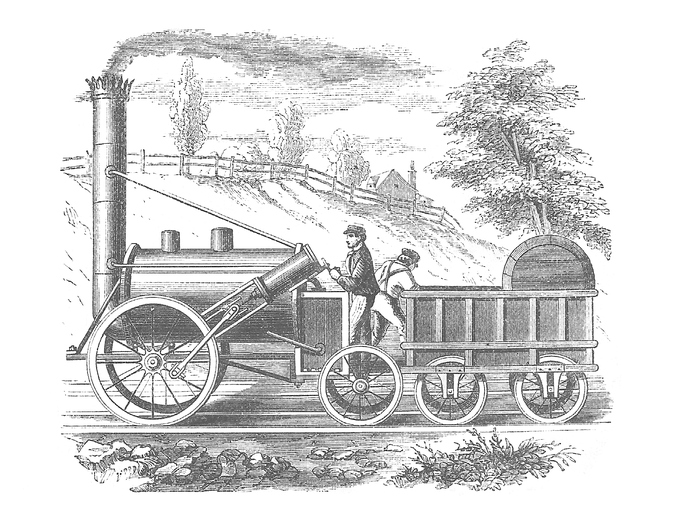
Introduced to this was Peter Hesketh, the young High Sheriff of Lancashire. It was probably at the opening ceremony of the Liverpool and Manchester Railway that he met with a group planning the Preston Port Railway Company. As Preston’s port facilities were extremely limited, they planned a railway link to the coast via railway, developing the destination as a port. Their intention was for Lytham, but Hesketh suggested his own land on the Wyre Estuary, then known as Rossall Warren and commonly called the Rabbit Warren by locals.
He set up a visit to the proposed site in October 1830 with a coastal trip from Skippool aboard the Lewtas, a local schooner. He invited a group of interested parties from Poulton and Blackpool, as well as the group from Preston.
Although the Preston Port Railway never came about, the High Sheriff stuck with the idea.
The year after, he changed his name by Royal Assent to Peter Hesketh Fleetwood. So began the story of Fleetwood.
1834-1837: Development of the harbour
Despite the failure of the Preston Port Railway Scheme, Hesketh-Fleetwood soldiered on with the plan, now as an MP for Preston, commissioning an exploratory survey into the suitability of linking the Wyre Estuary by a new railway from Preston.
George Landmann, a former army colonel, put together a report published in several country-wide newspapers in October 1834, and a new joint-stock company was set up.
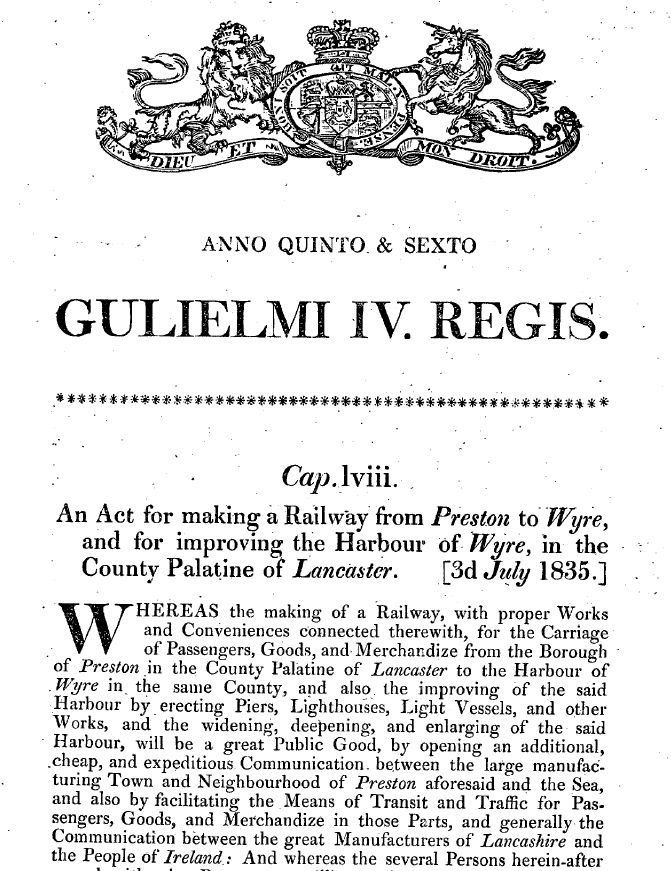
The port of FLEETWOOD, so-named after false-starts including Wyreton and New Liverpool, began in 1836 with limited facilities. Barges and small ships carried building materials to the area, avoiding carting them across the Fylde’s rough roads. Marker buoys laid in the harbour by the end of the year, improved the waters to shipping.
Weekly shipping reports by the Preston Custom House were published by the Preston Chronicle and the Preston Pilot, first mentioning in or at Wyre in 1836. From July 1837 it was known as Fleetwood or Fleetwood-on-Wyre, and was already recognised as a new seaport.
Design of the Custom House
The Custom House was designed as a fully detached building with a basement, a ground floor raised above pavement level by a series of steps, a first floor, then some rooms in the roof space. The building had entrances on all four sides which, because the ground floor was raised, had steps leading up to them.
Its architect was Decimus Burton, a founder member of the Royal Institute of British Architects at its inception in 1834. His father James was also an acclaimed architect and Decimus had access to and mentoring by most of the best British architects of the day. His design includes features typical of him, artistic rather than utilitarian.
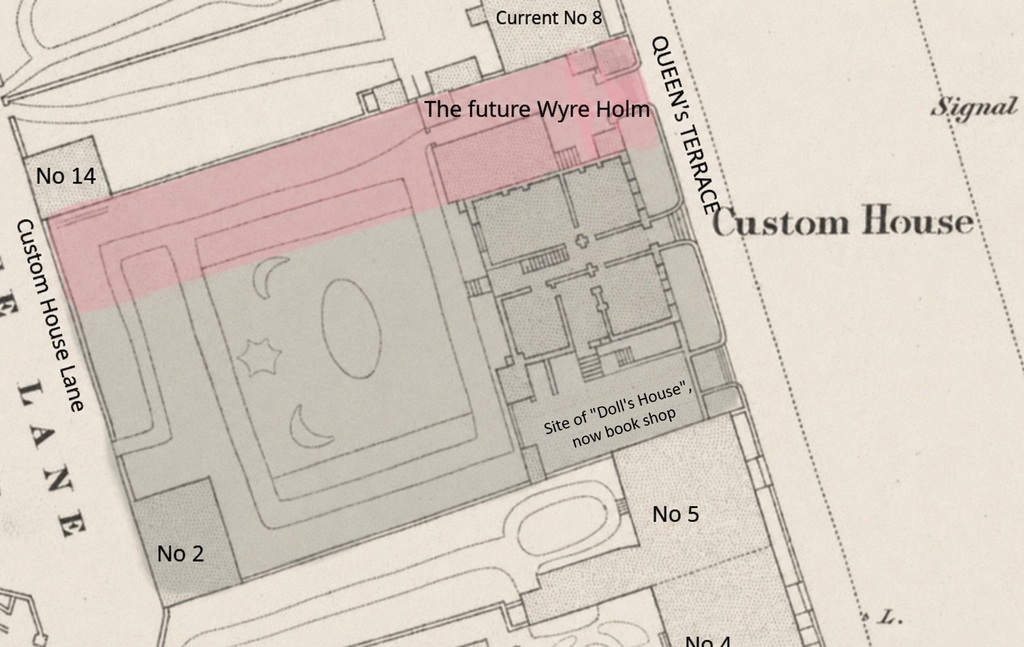
The above 1844 Town Map, one of the first made in high definition by Ordnance Survey (25 inches to the mile), shows the Custom House fronting onto Queen’s Terrace and with its garden backing onto Custom House Lane.
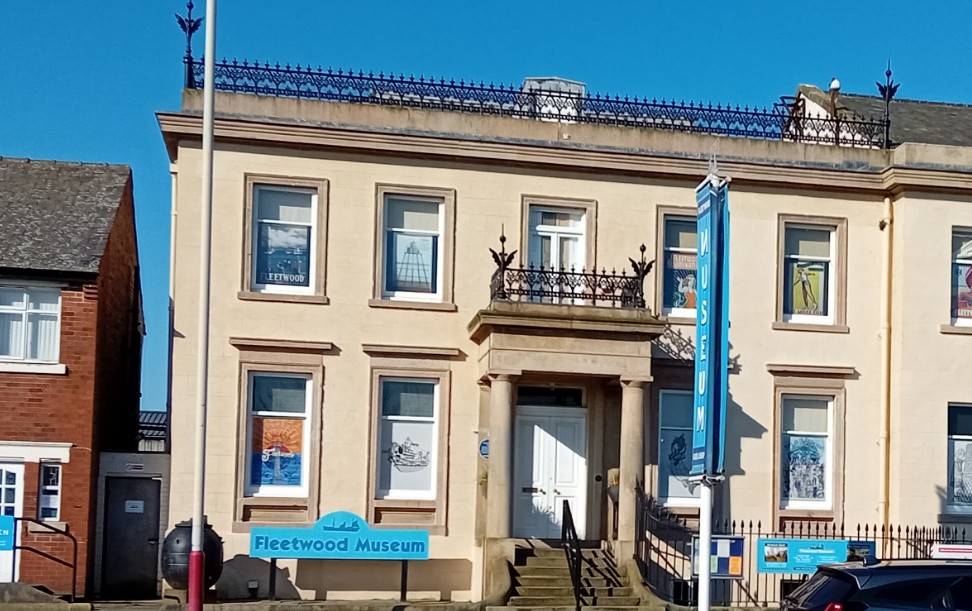
The original Custom House grounds included the site of Wyre Holm, now the righthand side of Fleetwood Museum, marked above in red. It was only completed in 1851, but we can see a rectangular part of it in the Wyre Holm site, possibly as a Custom House storage area for goods either seized as contraband or rescued from shipwrecks (the Customs Collector, Stephen Burridge, also held the position of Receiver of Wrecks, an appointment from the Admiralty). This room had steps leading down to pavement level and a doorway is one of two in the Victorian dining room exhibit on the ground floor, both included in the 1844 map.
It seems that the room inside the red area was adapted and divided from the Custom House in 1851, and incorporated into Wyre Holm when the architect Julian Augustus Tarner acquired the freehold for his new house. Even now, the basement of the Custom House extends below Wyre Holm.
The Custom House became the Town Hall from 1886. Around 1926 the Council took on Wyre Holm, initially as a rental, buying it outright in the second world war. The existing doorways between the Custom House and Wyre Holm were additions to improve access between the two buildings.
A house was built between No 5 and the Custom House in 1936, detached on both sides by narrow passages. This housed the mayoral attendant, whose wife was normally Town Hall caretaker. Walking through the passage between this house and the Custom House, it appears that a window was converted from a side doorway that originally had steps leading up to it.
We can also see two properties on Custom House Lane, “both two-up and two-down” cottages numbered 2 and 14. They had gardens in front of them and were enclosed with iron railings, and were auctioned off in September 1844, the year that the authorities demoted Fleetwood from port to “creek under Preston”. The sites of the cottages remain as nos. 2 and 14 Custom House Lane, although they may have been rebuilt.
In the two rear corners of the garden area were crescents separated by a star, all facing an oval area between the rear steps to the house and the star shape. A narrow pathway between the Custom House Lane cottages originally backed onto a back entrance on Custom House Lane.
1838-1839: Construction
This announcement appeared in the Preston Chronicle much later, on 4th August 1838:
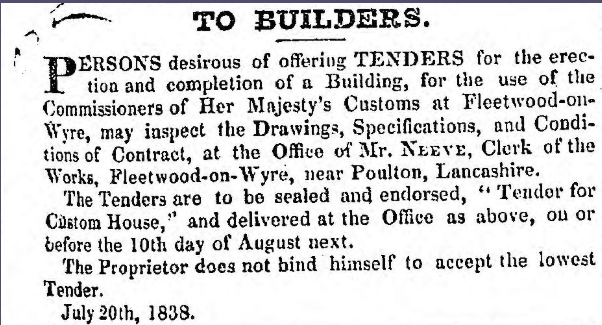
“The Commissioners of Her Majesty’s Customs at Fleetwood-on-Wyre” were James Crombleholme, the controller, and Stephen Burridge, the collector. Stationed at nearby Poulton, they would transfer to Fleetwood when its new Custom House was ready, bringing Poulton’s history as a river port to an end.
“Mr. NEEVE” was David Dixon Neeve, who became the first Postmaster in the town as well as the town surveyor.
The “Proprietor” was Sir Peter Hesketh-Fleetwood who had only recently become a baronet. Although referred to by the papers of the time as “Sir Hesketh”, he is remembered more simply as Sir Peter.
On page 3 of the same editions of the papers announcing the tender, came the following sad announcement.
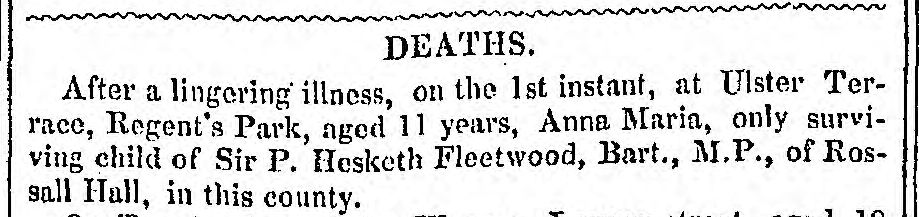
Grieving the loss of Anna Maria, he must have relied for support in the building of Fleetwood at this time from others. These included his brother, Reverend Charles Hesketh who also officiated at the Ann Maria’s funeral, his estate manager, Frederick Kemp, and his architect, Decimus Burton.
By this time, commuting between Poulton and the coast took up valuable hours for Customs officers. Building a Custom House in the town became a priority.
This progress update on the Custom House was reported in the Preston Chronicle on 23rd March 1839.

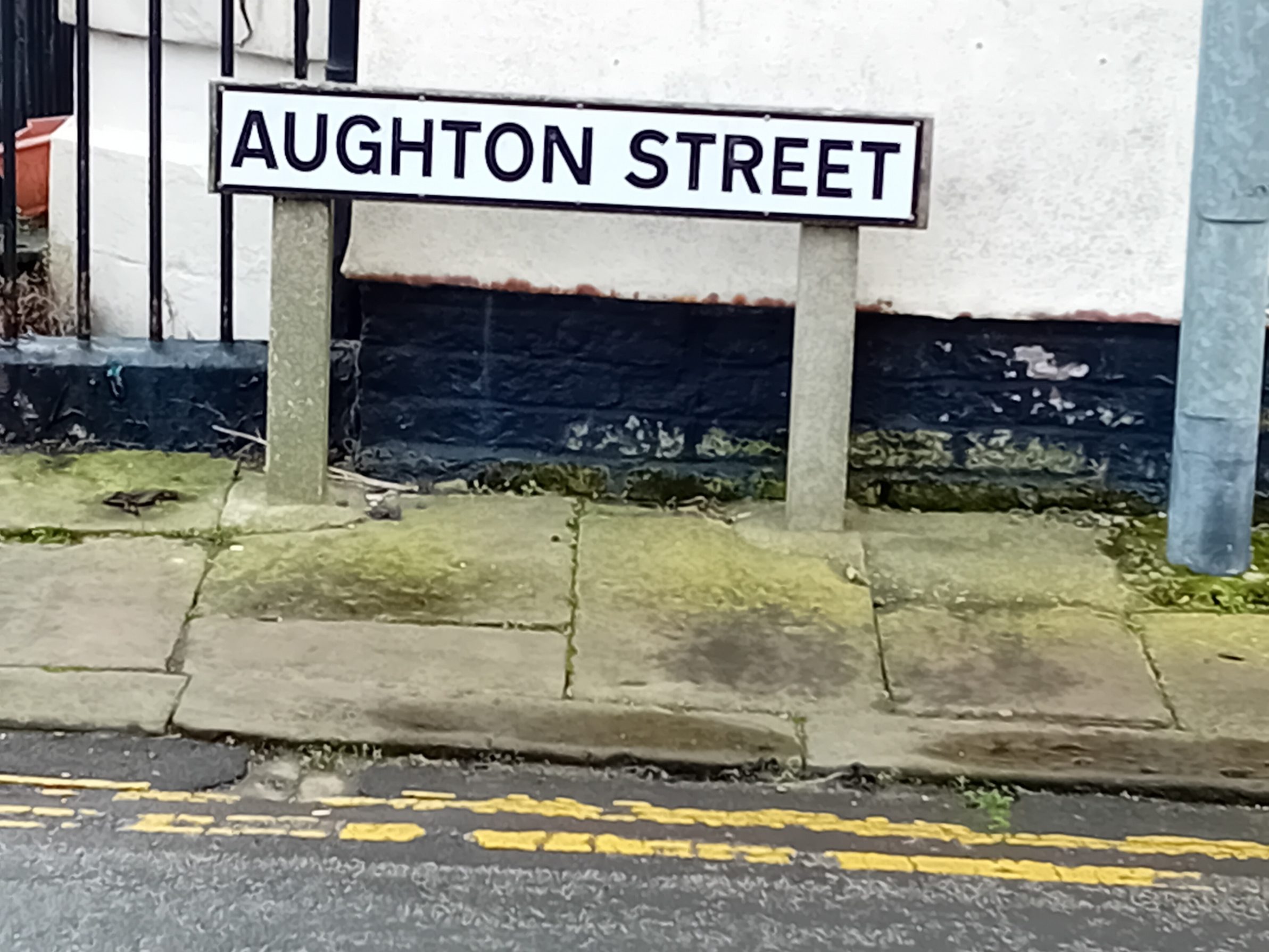
Preston-based Richard Aughton ran a construction firm which, by 1851 when his son was running it, had 35 employees. Not far from the Custom House, the name is commemorated in Aughton Street, an early street appearing on the 1844 map of the town.
A “rearing up” ceremony celebrated the end of groundwork and basement construction, when building work above ground level began.
Moving to August 1839, the Odd Fellows Society of Fleetwood celebrated their first anniversary. The Preston Chronicle reported a circular procession starting from the Victoria Hotel, passing the newly-built Custom House en route to the Mount.
No report of the opening of the building has been traced, but this appeared in the Chronicle on 14th September 1839.
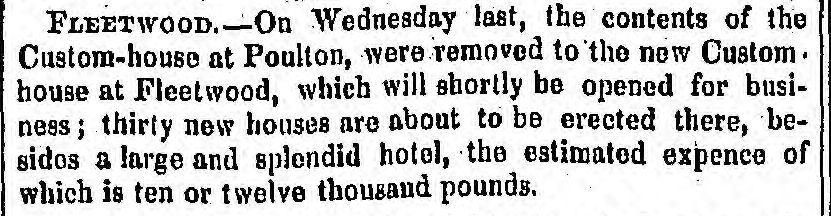
The “large and splendid hotel” was to be the North Euston.
James Crombleholme and Stephen Burridge were to be the first Customs officers for the new port, marking the end of the Poulton Custom House after well over a century, and a new phase for Fleetwood.
1839-1844: A working Custom House
Having opened its doors in an official capacity in September or October 1839, there is little information about the property until the 1841 census. Although its identity in 1841 is uncertain, it was likely to have been the family home of Customs controller, James Crombleholme. The Collector, Samuel Burridge, seems to have lived in the newly-started “Stone Terrace”.
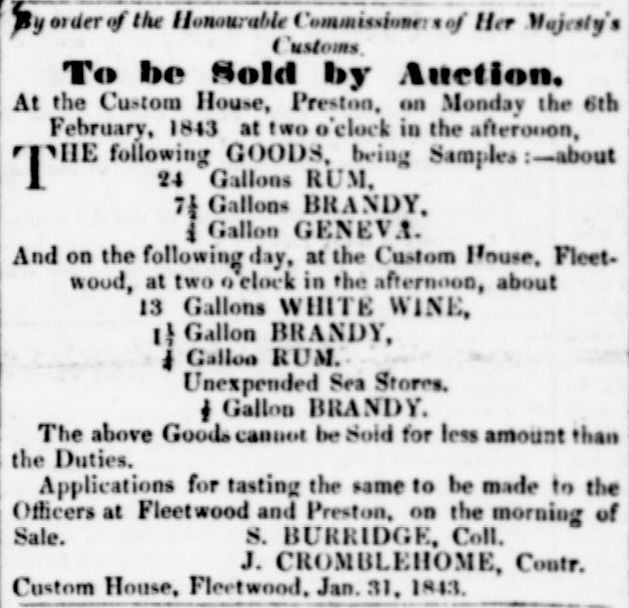
As well as being offices for the Customs with family accommodation, it had other roles, like holding an auction on Tuesday 7th February 1843, as shown at the end of this extract from the Preston Pilot on 4th February.
Twelve months later came dreadful news, the decision to demote Fleetwood’s status as a port, reported in the Preston Chronicle on 13th January 1844.
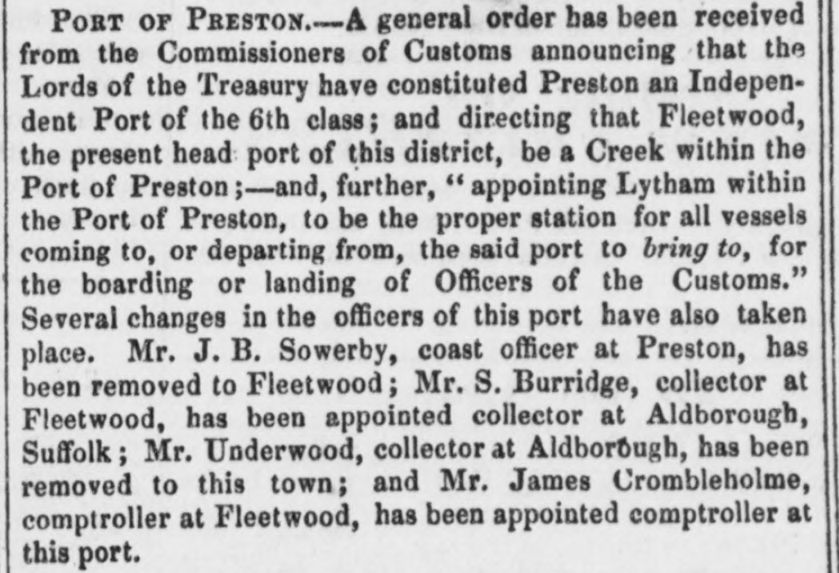
This followed a running battle for Fleetwood with the townships of Preston and Lytham, marking the end of the first period when the building collected duty.
Circa 1844-1851: The Lodging House
Sir Peter still held the freehold of most of the land occupied by the new town of Fleetwood in 1844, when the status of the port was reduced. The town was a seaside resort as well as being commercial. New properties being erected could either be rented via Frederick Kemp, his estate manager, or you could buy land or property under a long lease.
The Custom House had no long lease and was now empty. Furthermore, the continued development of Fleetwood was threatened as Sir Peter was financially overstretched. He could no longer afford the services of architect Decimus Burton, and his local home at Rossall Hall was now taken over by Rossall College, an Anglican boys’ school.
Mary Beesley, previously Mary Irwin, was employed by him for some years as housekeeper at Rossall Hall, and possibly before that as personal maid to Sir Peter’s first wife, Eliza Debonnaire Hesketh. His brother Charles officiated at the 1829 wedding of Mary Irwin and William Beesley at St. Chad’s, one of only three marriages he conducted there, even though he was the vicar, and he also baptised their son John the next year. The couple also had a daughter named Ellen in 1836, but Mary’s husband died in his early forties, becoming the first recorded burial at the Thornton church of Christchurch on 11th November 1837. This church was one of Sir Peter’s earliest gifts to the people of the Fylde.
Mary was clearly highly valued by the extended Hesketh family a a loyal servant who still had two young children to support and needed a home and income. Her reward was to be provided with the former Custom House, now addressed 6 Queen’s Terrace. This became a lodging house.
It was in a tourist area, and Mary used her housekeeping experience to turn it into a business. Evidence comes from the list of visitors in the July and August 1845 editions of the Fleetwood Chronicle, a paper established by local printer William Porter in 1843. The early rates books for Fleetwood and the 1851 census provide further evidence. Mary would have taken full advantage of Queen Victoria’s visit in September 1847 to Fleetwood. We see who stayed there from this list of visitors in the Fleetwood Chronicle.
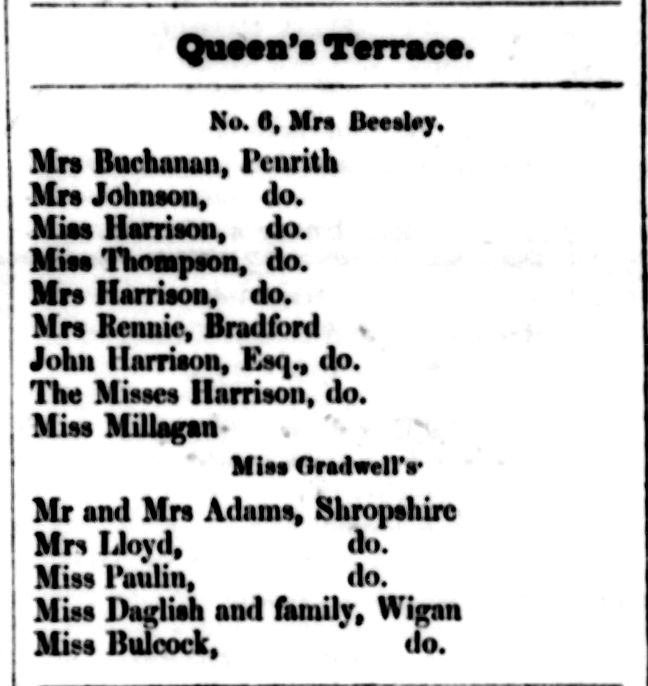
The 1851 census record is the last time that we can be sure that the Mary Beesley still occupied the Custom House. Referred to there as 6 Brick Terrace, an alternative name for this part of the Terrace, she had two visitors, one of whom was a Customs controller.
Sir Peter organised a special event at the North Euston at the start of 1850, celebrating the port’s independence from Preston. Customs adopted another building on Dock Street in preference to the original Custom House. For the next few years, the old Custom House became a family mansion house, but Sir Peter still had no buyer for it.
A change occurred in 1851 when Julian Tarner, one of the town’s first residents, built a new house using an area to the right of the old Custom House. This was to be Wyre Holm.
1851-circa 1862: Various occupants
The occupancy of the Custom House is debatable at certain periods. This is the case between 1851 and 1870.
According to the Mannex trade directory of 1851, published after that year’s census, Mary Beesley moved from 6 to 7 Queen’s Terrace.
The town’s improvement commissioners and its postmaster seem to have dithered over renumbering the houses. No number had been chosen for the newly-built Wyre Holm, so Mary’s new home at 7 Queen’s Terrace was what is now No 8. Unfortunately the valuation and rating lists show the properties from left to right, but the numbers represents the position rather than the postal address.
The 1861 census also avoided the issue of postal addresses. This reads from right to left, with Mary Beesley at schedule 47, then Julian Tarner, then Benjamin Whitworth, who lived at the Custom House, at schedule 49.0
There seems to have been no definitive account of property numbering for Queen’s Terrace in the period from 1861 to 1871, so guesswork is the order of the day.
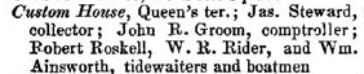
The 1851 Mannex directory includes the following entry, suggesting the reason Mary Beesley moved out was to allow Customs back in. The entry also shows the breadth of staffing at the Custom House.
Five years later there was an Irish doctor named James Augustine Orr advertising on 12th April 1856 in the Manchester Courier as below. Was he living in the old Custom House?

Although most cotton came via Liverpool, two major cotton traders traded through the port of Fleetwood, John Fielden of Todmorden and Benjamin Whitworth of Manchester. The latter made the town his home for about a dozen years and, by 1858 had moved from St. Stephen’s Place on Adelaide Street into the old Custom House. Although his name appears in the 1858 rates book, it was only as a short-term tenant, for Sir Peter had still not managed to sell a long lease on the Custom House. Fortunately, there is reliable evidence that Benjamin Whitworth lived at the Custom House, including the 1861 census. However, he decided to leave Fleetwood in 1862, as seen below.
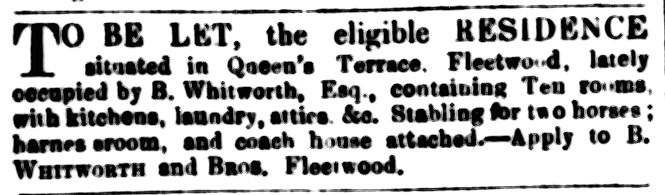
On 1st August 1862, auctioneer A Harrison auctioned all the contents of the Custom House occupied by Whitworth. He was moving to Drogheda in Ireland, returning as a visitor for the opening of the Whitworth Institute on Dock Street, claiming to have gifted it to the town.
He later offered a similar building to Drogheda. Fleetwood townsfolk were pleased at the time, but became disgusted in 1886 when he tried to sell his “gift” back to the town. The building changed its name to the Fielden Institute when Samuel Fielden, a successor to his cotton trading father John, paid Whitworth for the building and formally donated it to the town.
Benjamin Whitworth was clearly less generous than he tried to appear, maybe explaining his absence from many histories of Fleetwood.
The Custom House was ready for a new tenant.
1863-1870: More occupants & back to a Custom House
We have already referred to the 1851 Mannex directory, but another one was produced in 1866, with the following entry:
Custom House, Queen’s Terrace; Wm. Walker, collector
The building seems to have reverted to its original purpose for the third time, at least for a while. Walker was also the “collector of harbour light duties” from the same address, but there were other officers around town. Taxes and duties were now vital sources of Government revenue, maybe to help pay for the Crimean War in the 1850s.
1866 is a key year in Fleetwood’s history. Sir Peter Hesketh Fleetwood, owner and landlord of the former Custom House, died on 12th April 1866 aged 65. He was succeeded as baronet by his son Louis Hesketh Fleetwood, who was faced with a complex estate to be managed by the Fleetwood Estate Company, together with many debts to be settled. This entailed parting company with the Custom House, which was amongst the town’s oldest buildings.
Nearly four years later, on 28th January 1870, the Fleetwood Chronicle listed 128 lots of property to be sold the same day, Friday, and Saturday. The same advert had already appeared the previous four weeks, and was placed in other newspapers across the country.
The tenant at the Custom House was now William Dickinson, described in the 1861 census (when he lived further along Queen’s Terrace), as a land proprietor. Customs had obviously vacated the old Custom House for a second time.
The next week they listed the lots, both sold and unsold, on the first day. The old Custom House appeared as lot 5, as below.
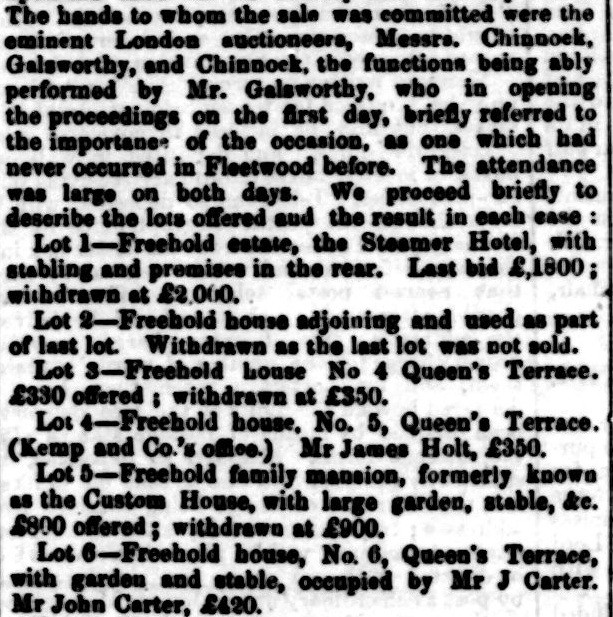
Of the first six lots, all in the same patch of Queen’s Terrace, only two sold.
The old Custom House, described as a freehold family mansion, was withdrawn from the auction because the highest offer was too low. When no offer was received for £900 (about £93,500 in January 2026), the lot was withdrawn.
However, lot 6 (the current No. 8) was sold, as well as No. 5, the office of Kemp and Co.
Circa 1871-1885: Alexander Carson
Like Benjamin Whitworth, Alexander Carson made his money in Manchester, but not from textiles. He imported clocks, first from Germany and later from North America. He also had a younger brother named Samuel working with him, who lived at No. 1 Stone Terrace.
The 1870 auction of Sir Peter’s properties had included the name “Mr. Carson” in a number of successful bids, including properties on both Lower Dock Street and Stone Terrace, including No. 1. Although there was no successful bid for the former Custom House, the 1871 census showed Alexander Carson as the new occupant; he presumably made a later private offer for the property.
Judging by the spending spree of “Mr. Carson” at the 1870 auction, which could have been either Alexander or his younger brother Samuel, the family’s bulk clock dealing was highly lucrative. The family had originally moved from Scotland to Manchester, also living at one time in Huddersfield. Although Alexander and his father James were both shown as “hawkers” when living at Canning Street in Manchester in 1841, the term applied to many travelling sales people; the Carson family were obviously good at business.
Alexander married Martha Midgeley from Huddersfield at Manchester’s Presbyterian church in 1842, by which time he and his father were described as clock dealers. Alexander re-invested his hard-earned profits in his chosen trade. His clocks and watches originally came from Germany, but were latterly imported from North America.
He died in 1885, leaving an estate then valued at £21,269 (equivalent to £2 million in January 2026). His obituary and funeral were covered in detail by the Fleetwood Chronicle on 13th November. As Fleetwood had no Presbyterian church, he attended the Congregational church, tirelessly fund-raising and becoming its Sunday School teacher. He was also involved with most Fleetwood institutions, became a JP, and had chaired the Whitworth Institute.
The Carson family had named their family mansion house (as it was described in the 1870 auction) “Oakville”. The death of Alexander Carson marked the end of Oakville’s life as a dedicated personal residence.
10 Sept. 1886: Gentleman’s Residence for sale, by auction
The former Custom House, known as Oakville for about 15 years, was now empty following the death of its owner about ten months earlier. The property was all the more significant because Alexander Carson had been one of the richest people in the town, and a positive influence for several years. Samuel Carson survived his brother but decided to leave Fleetwood.
We have a new auction in 1886, There were two lots in this auction, the 2nd being No. 1 Upper Queen’s Terrace where Samuel lived. The auction was held at the Crown Hotel on Friday 10th September 1886.
For a transcription of the auction advert, including a detailed description of the property layout in 1886, see this link →.
1886: A Town Hall for the Improvement Commissioners
Local governance in Fleetwood began in 1842 through Sir Peter’s Act of Parliament creating a Board of Improvement Commissioners. This still existed in 1886, although with an altered constitution.
Sir Peter first choice of meeting place for the commissioners was the North Euston Hotel, but it became an Army School of Musketry, so a new venue was needed. Various places were used over the following decades, and London Street had become a semi-permanent boardroom by 1886. However, they wanted a permanent home that they did not have to rent, a Town Hall.
The former Custom House, although rather small, just about met their requirements. Admittedly, for a town with such a large infrastructure to support, the old Custom House was not ideal, but it was a start.
On Tuesday 9th November 1886, the board held its first meeting at its new premises, chaired by Mr. W. Seed. Business included the construction of sections 1 and 2 of the new promenade, allocating the old boardroom on London Street to the fire brigade, and appointing Robert Moore as Mount-keeper, whose many duties included reports to the Meteorological Office.
It appears, from this first report from the new premises, that they had paid a total of £1,405 to the executors of the late A. Carson. We also learn that deeds and documents were to be kept in a safe in the Town Clerk’s new office.
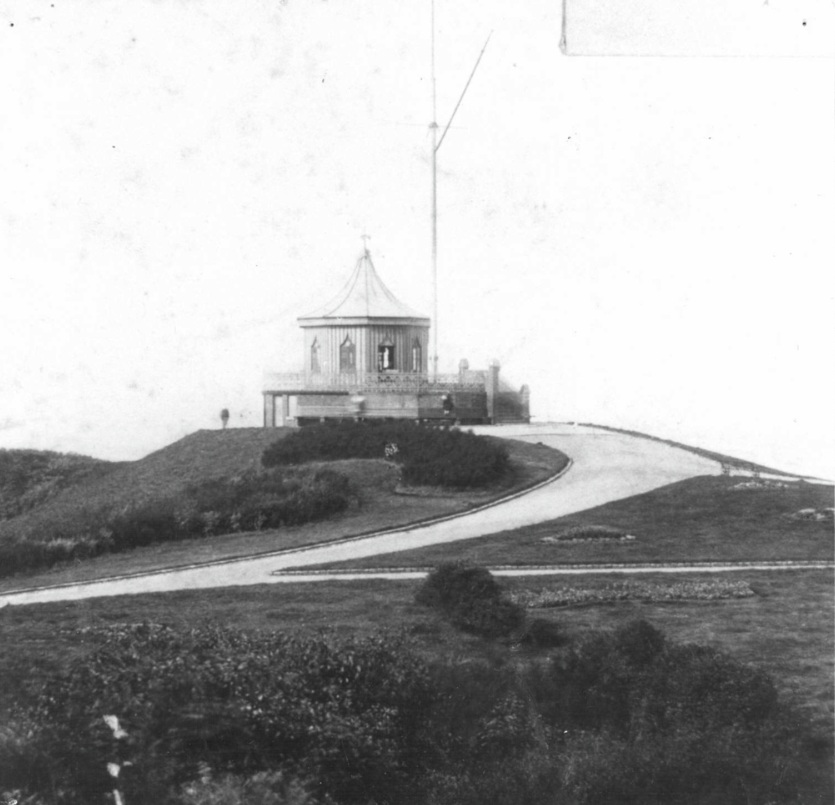
The committee also decided to photograph the Mount from four points. The photograph below, being the old pavilion, may have been one of these. Also on the agenda was the appointment of a Town Hall caretaker.
We pause this history here. The Town Hall absorbed Wyre Holm around 1926 remaining as Town Hall without interruption. This ended in 1974 when the borough of Fleetwood was absorbed, with others, by the newly-created Wyre Borough Council.
The 1839 Fleetwood Custom House